

HOW WE CAN WORK TOGETHER
Work that contributes to our collective and planetary wellbeing offers an antidote to cynicism, while cultivating agency, meaning, and an undeniable inner power at the individual level. I connect commercial teams to this deeper mission, and I build the capacity of those already pursuing purpose.

Corporates
Amid turbulent times, I firmly believe that it's purpose and a deeper mission that keep teams rowing in the same direction. Pursuing a deeper value than profit alone will be defining for your organisation. Here's what I can bring:
-
Activating impact using levers such as volunteering, funding, product, procurement, space.
-
Embedding purpose and meaning in the staff journey.
-
Designing and delivering multi-year social impact strategies.
-
Nonprofit partnership design, relationship management and community consultation.
brands
Through long-form storytelling I’ve amassed hundreds of thousands of views on content that is truly meaningful. We'll partner to communicate brave messages and genuine impact with your community. That often looks like:
-
Facilitation and delivery of meaningful, community facing activations.
-
Copywriting and key messaging for purposeful campaigns.
-
Credibly representing genuine impact through creative storytelling, with any audience, and through any medium.
SOCIAL ENTERPRISES & NONPROFITS
I've partnered with a vast array of Nonprofits and Social enterprises, and know their challenges well. I build the capacity of impact first organisations with deep expertise across:
-
Impact storytelling.
-
Recruiting & empowering advocates, champions, volunteers & team members.
-
Strategy & theory of change.
-
Connecting you with resources, partners, global networks and ecosystem support for purpose-led organisations.
My Approach
There is a profound power that stems from finding meaning in our work. I have felt this power, and I advocate for a deeper mission behind enterprise every day. This has been Canva’s mission to ‘do the most good it can’. Now I bring my own philosophy:
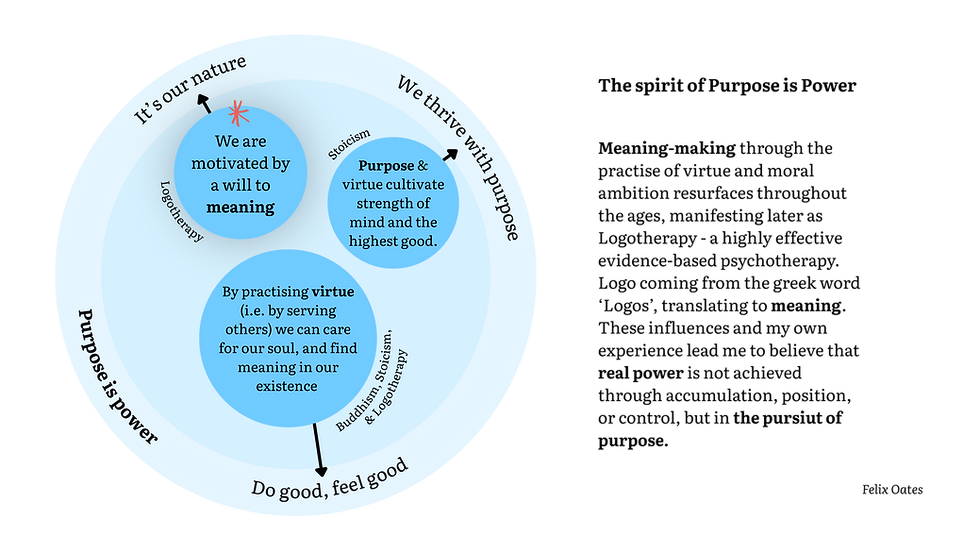
Power -of the material kind- stems from capital wealth, position, status, and influence, to name a few. To some degree, many of us have become indoctrinated by a system that leaves us wanting for these attributes. To say that those attributes, or power itself, are inherently good or bad is entirely subjective. Though, an insatiable need for such power and those aforementioned attributes can lead us down a path of self-abandonment when that need overrides values, or even when we attach our happiness to such things. While the pursuit of power in this context can present as positively defensive, i.e. to control one’s prospects, or that of one’s family, such control (albeit well-intentioned) is an illusion. We are not in control. What is there to be done amid such emptiness then? Roll back any measure of self-betterment? Relinquish our fate? No. We all have agency, and there is space to discover a different, more intrinsic power entirely.
Material power often carries the perception of darkness, distrust, or domination for emerging generations, and is individualistic in it’s nature when it’s not wielded for the good of the collective. There is another kind of power, though, that arises internally from alignment with values, connection with others and to the natural world, service, and value creation for society. While material power and wealth can (and must) serve our needs to a point, the alternative power I speak of is an inner force with which we can deeply enrich the lives of others -and ourselves in turn- in ways that a posting or pay check simply cannot. I’m speaking about the power of purpose.
To sit with a friend in their suffering and to know that they felt seen, supported, and even saved. To honour your opportunity to empower a young person who hasn’t before heard such encouragement. To volunteer your time in service of someone experiencing hardship without want of anything in return. Not only do such experiences have the potential to alter the course of someone else’s life, but they stir up a powerful force for good within us. Engaging with such experiences are a most effective way of caring for our own soul and mind.
Personal experiences
I felt this power for the first time in India, volunteering in slum communities. At the time -albeit with undiagnosed neurodivergence- my teenage self knew self-abandonment and was largely unaware of his privilege; particularly access to Education (which I was often truant from), and sport. 4 months in India was not only a humbling (and a kick up the arse), but it was the first time I’d truly felt the connection between service of others and my own spiritual health, even if I wasn’t yet open to such concepts. There’s a science to this.
While still struggling with the poor mental health that stemmed from my (still undiagnosed) neurodivergence, it was some years before I could access senses of meaning and purpose in my corporate career with Google & Canva. This was through service (particularly, volunteering) with Canva, where I was reminded of the life changing power that stems from living in alignment with your values and serving others. While leading Social Impact efforts in Canva’s biggest region, there were profound learnings that came from connecting skilled thousands of staff at Canva to community projects and social causes. I brought huge scale to volunteering programs, all while getting to know the generational change makers our programs aimed to empower. “This is the best part of my job”, staff would say, and “the reason I joined”. The change-makers we were supporting though (Nonprofit & Social Enterprise leaders), more than any cohort I’d met, had all located a profound power within them. Wether it came from lived experience, compassion for others, representing and leading their community, there was an inner power that allowed them to show up unapologetically and fearlessly in pursuit of positive change.
Philosophy
I was eventually fortunate to receive the support and diagnoses I needed, but service and higher moral ambition were always key parts of attaining better mental health. As was spirituality. ‘Cherishing others’ is an object of virtue that’s central to Buddhist philosophy. It’s a philosophy that is grounded in compassion for others. With compassion we can experience (at the very least) semblances of a happy and peaceful mind. Siddartha Gautama (Buddha; a human like the rest of us) taught the power of cherishing others 2500 years ago. The idea that we can attain happiness and even meaning in our lives through such practices would continue to resurface across borders, cultures and faiths throughout millennia. Buddha had a rather well known contemporary in the west, Socrates, who taught during the same period that the practise of virtue (living by a high moral standard) was the best way to care for ones soul, and to hurt others was to deeply hurt yourself.
Socrates’ Athenian spirit permeates the beliefs of the Stoics. When one of the most powerful humans of all time, Marcus Aurelius (a self-declared Athenian), speaks of tolerance, of moral integrity, service, and retreating into oneself all in order to care for ones-self, how can we possibly ignore such reflections? Such reflections from an Emperor, or even from Seneca, who was an advisor of emperors and billionaire in todays terms, who scorns purple robes, vices and luxuries while reminding us that with virtue we can achieve the highest good. Rome was evidently far from perfect, and while the Stoics may not have had the purity and divinity of the Buddhists, there’s no question they served the good of their people, the empire, and Rome. Reading such detailed, obsessive, and complex introspections that draw so many correlations to our challenges of today show that, in so many ways, our brain chemistry hasn’t changed very much at all. Such characters dealt with the corrupting forces of the kind of power we opened with, and broke through such forces to achieve a legitimate inner power at the individual level, grounded in a life of moral ambition.
The conflict of light and dark held in power comes to a head with Nietzsche, perhaps one of the most controversial but misappropriated commentators on humans’ ‘will to power’. Nietzsche suggests that our irrational will for power can lead to domination or benefit of others alike, but it’s clear that Nietzsche has a preference for the sublimation to this ‘will to power’ through positive creative activity that can lead to self-sufficiency. To that end, the Nietzsche quote central to our message at Purpose is Power is this; ‘those with a strong enough why can bare almost any how’. For us, this quote stands for the idea that if our convictions and reasons for doing something are strong enough, we can cope with and even thrive amid the most difficult of conditions. The ‘why’ is the source of our intrinsic power. Of course, we think that a strong enough why - a why that is enduring and impenetrable - is grounded in virtue.
To close on the philosophical set of beliefs behind purpose is power, we introduce Viktor Frankl. The aforementioned quote by Neitzsche was one I first read in Frankl’s book ‘Man’s search for meaning’. Frankl -a Psychiatrist, Holocaust survivor, and Logotherapy Founder- takes this message from Neitzsche (and his ‘will to power’) and positively reinterprets it into a ‘will to meaning’, which he presents as one of man’s most fundamental drivers. This is the drive to find meaning in our existence, with Frankl also proposing that we all have agency to discover such meaning in our individual human experience. In that sense, Neitzsche and Frankl would agree that meaning is made in ones life. Though, Frankl’s ‘will to meaning’, moves away from the idea that we have a drive for domination, and rather for purpose.
We all seek meaning and purpose, and they can be found in suffering, but solidified through love, compassion and contribution. These ideas are foundational to Frankl’s ‘Logotherapy’, a highly successful psychotherapy practice. Logo is the greek word for ‘meaning’. At Purpose is Power we believe that we can create meaning by practising virtue, whether that is through serving others, by doing work that respects and cares for our planet and the collective, that creates deep value for society, and that empowers the next generation and those with an experience of disadvantage.
Of course, any corner of human knowledge can validate one person’s experience, and there’s no part of this manifesto that is truly concrete. That said, sometimes we have to look beyond the objectiveness of the names and constructs and engage with the metaphysical in order to find truths and meaning in our existence, before showing up with a positive vision. In such a pursuit of purpose, we believe it’s inevitable that we eventually locate a force for good within us; a raw power that could positively change our own lives and that of others.
Purpose is Power is a huge bet on this philosophy. We are building a capability grounded in the experiences of Felix and the change-makers he’s partnered with, based on the compelling business cases for embedding purpose into your organisation and for pursuing a deeper value than profit alone. We’re also listening to what the next generation are telling us about the kind of work that they want to do. There’s a blue sky on our website, but don’t be fooled; this blue sky thinking is grounded in economics, clear business cases, good governance, self-sustaining models, social entrepreneurship and innovation. We are ready to partner with Corporates with an ambition to activate purpose and impact in their commercial operations, with brands that hope to communicate brave messages and genuine impact with their community, and with Nonprofits and Social Enterprises already on the pursuit of purpose and eager to innovate. We are not just another advisory or consultancy; we’ll actually deliver work that will far outlive our collaboration, without the need for investment in headcount. Reach out to Felix if you’d like to hear more about one of our streams of work.
How can friends and family support Felix? Share the website with someone in your network that would enjoy this thinking. It’s a one-man team for now, so the ‘we’ mentioned in the essay are the countless folks who have helped (and continue to help) me to forge this thing!
